
.webp)
.webp)
.webp)












The Philippine AI Report 2025: Retail Edition is a free, data-backed guide to where AI is working in Philippine retail and where it stalls. It takes the findings of a 175-organization national survey and applies them to the retail value chain, then maps them against the cost pressures of the 2026 energy emergency.
The report is built for the people who own AI decisions in retail. That includes business leaders, innovation and transformation heads, and operations, supply chain, and merchandising executives at mid-market and enterprise retailers. If you are weighing where to invest, how to move a pilot into production, or how to defend margins under the current cost shock, the findings speak directly to your decisions. Modern trade chains, e-commerce platforms, sari-sari networks, and logistics operators each find sections mapped to their reality.
The findings rest on primary research and verifiable sources. They draw on a national survey of 175 organizations across 47 questions covering AI deployment, tools, workforce impact, barriers, and plans. The retail analysis layers in 70 cited sources, including Philippine government data, global research from McKinsey and BCG, and APAC retail benchmarks.
Yes. The Philippine AI Report 2025: Retail Edition is free to download.
The Pilot Trap is the gap between experimenting with AI and running it in production. In the Philippines, 92% of organizations have adopted AI in some form. Only a minority scale it. 65% remain at the proof-of-concept (POC) stage, the point where a pilot proves an idea works before it reaches daily operations.
92% of Philippine organizations have deployed AI in some capacity, according to the Philippine AI Report 2025 survey of 175 organizations. Commitment runs deep at the top: 61% report C-level backing for AI initiatives, and 54% have used generative AI tools for more than twelve months. Tool adoption is led by ChatGPT at 83%, followed by Google Gemini at 62%, Claude at 44%, and Microsoft Copilot at 39%.
The 2026 energy emergency has raised retail operating costs across logistics, electricity, and store hours in a single quarter. President Marcos declared a state of national energy emergency under Executive Order No. 110 on March 24, 2026. Logistics inputs rose 20% to 30%, with inter-island shipping caps reaching 40%. Wholesale electricity prices were projected to nearly double, from around PHP 5 to more than PHP 9 per kilowatt-hour. These pressures turn AI-driven forecasting and route optimization into direct margin defense.
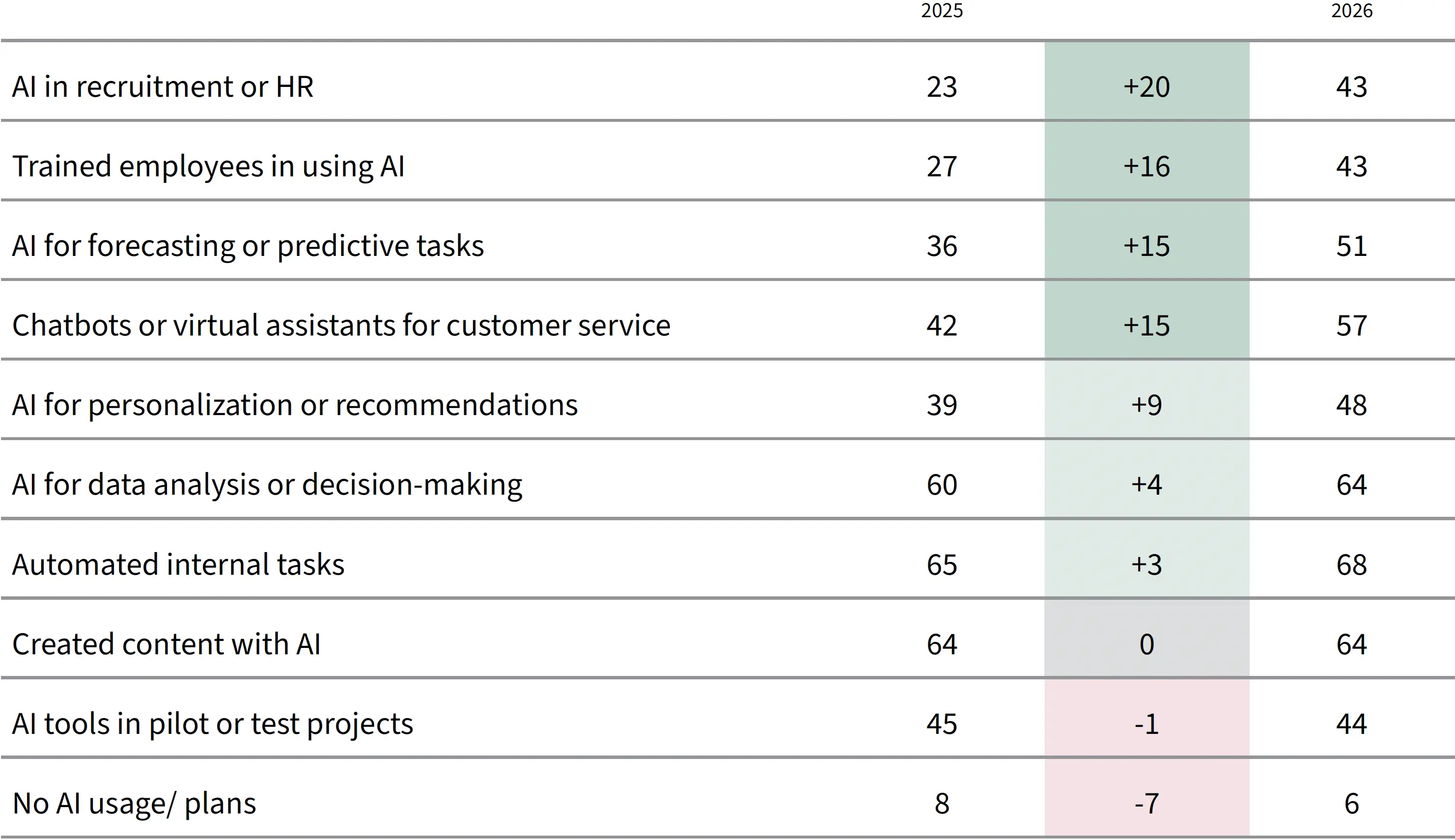
Four AI use cases deliver the most immediate value for Philippine retail. The first is demand forecasting, projected to grow from 36% to 51% adoption. The second is logistics cost management, where route optimization and co-loading lower fuel spend across a 7,641-island supply chain. The third is back-office automation, where invoice processing has dropped from four weeks to two days in domestic deployments. The fourth is customer experience, where service chatbots show the highest planned growth of any application, rising from 42% to 57%.
Shadow AI is the use of personal AI tools without finance or IT oversight. The Philippine AI Report found 42% of employees pay out of pocket for AI tools they use on the job. The tools they reach for are consumer platforms that retain user inputs under consumer terms of service. For retail, the exposure concentrates in three areas: customer and payment data, pricing and competitive intelligence, and the scale of a workforce above 10 million. An employee pasting customer or pricing data into a public tool moves regulated information outside the organization's control. Provisioning governed enterprise tools is the practical fix.
NPC Advisory No. 2024-04 applies the Data Privacy Act directly to AI systems that process personal data, and it is already in effect. The National Privacy Commission (NPC) issued it on December 19, 2024. Retailers stay accountable as Personal Information Controllers (PICs) for customer data that their AI systems process, even when a third-party vendor does the processing. The advisory requires plain-language disclosure of how AI uses customer data, a Privacy Impact Assessment (PIA) before deployment, and privacy-by-design built into the system from the start.
The Philippine AI Report 2025 was produced by Swarm, a global AI consultancy that has deployed over 100 AI projects to production across 12 countries. Website: swarm.work — For research inquiries: pia@swarm.work — For enterprise partnerships: shiela@swarm.work
