





.webp)
















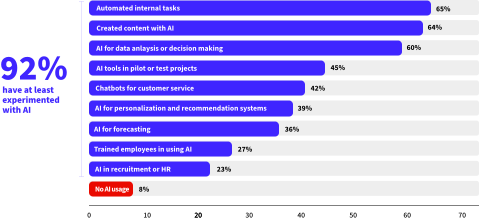
Over 92% of Philippine organizations used AI in some capacity in the last year. Only 8% of organizations report having no AI usage or plans for the future.
What this means for leaders: AI is no longer an optional technology for early adopters; it has reached critical mass and is a standard component of the competitive landscape.
Source anchor: Part One: State of Play; Exhibit 4
The majority of companies are experienced with AI: 54% of organizations report having used Generative AI tools for 12 months or more. An additional 20% have used them for 7-12 months. Only 2% are just getting started with less than one month of use.
What this means for leaders: The early-mover window is closing, and competitors are already accumulating a year or more of learnings from their AI initiatives.
Source anchor: Part One: State of Play; Exhibit 1
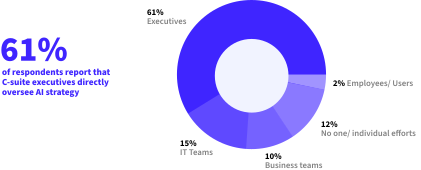
AI strategy is predominantly led from the top, with 61% of respondents reporting that C-suite executives directly oversee their company's AI initiatives. IT teams lead in 15% of companies, while business teams lead in 10%. In 12% of organizations, there is no formal leadership or AI strategy relies on individual efforts.
What this means for leaders: Executive ownership signals that AI has become a strategic priority, increasing the pressure to deliver measurable business outcomes beyond experimentation.
Source anchor: Part One: State of Play; Exhibit 2
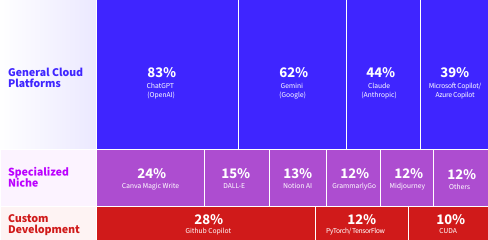
General cloud platforms dominate usage, led by OpenAI's ChatGPT (83%), Google's Gemini (62%), Anthropic's Claude (44%), and Microsoft Copilot/Azure (39%). Among developer tools, GitHub Copilot is used by 28% of organizations. Design tool Canva's AI features reach 24%.
What this means for leaders: The market has rapidly standardized on a few major platforms, making it easier to find talent with relevant experience but also creating dependence on third-party ecosystems.
Source anchor: Part One: State of Play; Exhibit 3
The vast majority of companies are buying or accessing AI capabilities through ready-made platforms and SaaS tools. Only 12% report using development frameworks like PyTorch or TensorFlow, and only 10% use CUDA for GPU computing. This indicates that custom, in-house model development is a niche activity.
What this means for leaders: The dominant strategy is to prioritize speed to value by leveraging existing platforms, accepting a trade-off between rapid deployment and reliance on third-party vendors.
Source anchor: Part One: State of Play; Exhibit 3
The Technology, Software, and IT Services sector is the most advanced, comprising 37% of survey respondents. This is followed by Financial Services (Banking/Insurance) at 14%, reflecting that sector's significant early investments in AI for risk modeling, fraud detection, and customer service.
What this means for leaders: While tech and finance lead, adoption is present across nearly every major economic sector, indicating AI's broad applicability.
Source anchor: Part One: State of Play; Exhibit 6
AI adoption spans all company sizes, from small businesses to large enterprises. Small businesses (fewer than 100 employees) make up the largest group of adopters at 55%, while organizations with 100-999 employees represent 14%. Mid-to-large enterprises (1,000-9,999 employees) account for 18%, and very large organizations (10,000+ employees) represent 13%.
What this means for leaders: Small organizations can leverage AI for agility, while large enterprises face greater complexity in integrating AI across legacy systems but have more resources for dedicated AI teams and governance.
Source anchor: Part One: State of Play; Exhibit 6
The primary bottleneck is moving from successful experiments to enterprise-wide deployment. While over 92% of companies have used AI, 65% remain stuck at the proof-of-concept (POC) stage.
What this means for leaders: The central challenge is no longer about proving AI's value in a controlled setting; it's about overcoming the technical and organizational hurdles to integrate it into core business operations.
Source anchor: Part Two: The Approaching Plateau; Exhibit 7
A significant majority of 65% of organizations report that their AI projects remain at the proof-of-concept stage. This is the most common type of AI project, far outpacing AI application development (47%) and end-user AI enablement (41%).
What this means for leaders: Your organization is likely not alone if it is struggling to scale, but competitors who break out of the POC stage will gain a compounding advantage.
Source anchor: Part Two: The Approaching Plateau; Exhibit 7
The "POC Trap" is when the proof-of-concept phase, intended to be temporary, becomes a permanent condition. Companies fall into it due to internal development hurdles (cited by 34%) and the paradox of off-the-shelf tools, which enable quick pilots but stall at the complex integration stage.
What this means for leaders: A strategy focused only on rapid experimentation without a clear path to integration will likely result in a portfolio of isolated, unscaled pilots.
Source anchor: Part Two: The Approaching Plateau; The POC Trap
A "wide and shallow" strategy involves experimenting across many different use cases (automation, content creation, data analysis) but with surface-level implementations that are not deeply integrated into core systems. This is evidenced by high use of general platforms but very low use (12%) of frameworks for custom development.
What this means for leaders: This approach is a logical starting point for quick wins, but it does not build the deep, integrated capabilities required for durable competitive advantage.
Source anchor: Part Two: The Approaching Plateau; Wide and Shallow vs. Deep and Integrated
Individual adoption involves employees using tools like ChatGPT for personal productivity gains. Organizational adoption is the strategic integration of AI into core business processes, supported by appropriate data infrastructure, governance frameworks, and measurable outcomes tied to business objectives.
What this means for leaders: Simply providing AI tool licenses to employees is not an AI strategy; it is an accommodation of individual behavior that does not generate compounding business value.
Source anchor: Part Four: The Path Forward; The Gap Between Individual and Organizational Adoption
According to Sherwin Pelayo of the Analytics & AI Association of the Philippines (AAP), AI failures are rarely model problems; they are fundamentally data and infrastructure problems. Many organizations attempt to operationalize AI on fragmented data, with weak governance and legacy IT architectures.
What this means for leaders: Investing in sophisticated AI models without first strengthening data foundations is a recipe for projects that stall at the pilot stage.
Source anchor: Part Two: The Approaching Plateau (Expert Commentary from Sherwin Pelayo)
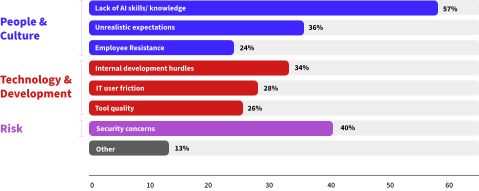
A lack of AI skills and knowledge is the single biggest barrier, cited by 57% of respondents. This talent scarcity significantly outpaces all other challenges, including security concerns (40%) and technical hurdles (34%).
What this means for leaders: Your AI strategy is fundamentally a talent strategy; without the right people, even the best technology and executive support will fail to deliver results.
Source anchor: Part Three: Structural Barriers; Exhibit 8
Organizations show a significant lag in hiring for strategic and governance roles. Key missing positions include AI Strategy Lead (17%), AI Product Manager (11%), and AI Compliance/Governance Officer (12%). Machine Learning Specialists remain at only 14%.
What this means for leaders: The absence of these roles is a primary reason why AI initiatives remain disconnected from business objectives and fail to scale beyond the pilot stage.
Source anchor: Part Three: Structural Barriers; Exhibit 9
A significant portion of the market lacks dedicated AI talent, with 20% of organizations reporting they have no AI-related roles at all. An additional 9% are unaware if such roles exist within their company.
What this means for leaders: There is a clear divide between companies actively building AI teams and those still on the sidelines, creating a widening capability gap.
Source anchor: Part Three: Structural Barriers; Exhibit 9
The Philippines ranks sixth in ASEAN for the volume of AI-related research publications, trailing Malaysia, Singapore, Indonesia, Thailand, and Vietnam. Research capacity is concentrated in Metro Manila, with De La Salle University, Mapua University, and UP Diliman leading output.
What this means for leaders: The national talent pipeline is structurally misaligned with industry needs, increasing the risk of becoming dependent on foreign expertise for advanced AI work.
Source anchor: Part Three: Structural Barriers (Expert Commentary from Karl Ezra Pilario, PhD)
In the previous year, 27% of organizations provided AI training for their employees. This number is projected to grow to 43% in the next year, reflecting a growing awareness of the need to upskill the workforce.
What this means for leaders: While the intent to train is growing, the current level of investment is not keeping pace with the rapid adoption of AI tools, creating a gap between access and capability.
Source anchor: Part One: State of Play; Exhibit 4 & Exhibit 5
Security and privacy concerns are the second-highest ranked barrier to AI adoption, cited by 40% of organizations and trailing only the talent gap (57%). Top concerns include data breaches from exposing sensitive information to third-party services, regulatory compliance violations, and vulnerabilities in the AI systems themselves.
What this means for leaders: Trust is a critical prerequisite for scaling AI; without robust security and governance, promising initiatives will be blocked by risk-averse stakeholders.
Source anchor: Part Three: Structural Barriers; Exhibit 8
