The first sector-specific benchmark mapping AI adoption across Philippine retail.
We identify where AI creates real margin impact across the value chain, what stands between pilots and production, and what retail leaders need to do to scale.
Thank you! Your submission has been received!
Oops! Something went wrong while submitting the form.
FROM PHILIPPINE AI REPORT 2025
Where does the Philippines stand in the AI race?
We surveyed 175 Philippine organizations across sectors, and here’s what we found: 92% have already experimented with AI. Employees aren’t waiting for permission. They’re bringing their own tools. Policy is moving. Investments are underway.
1. The retailers scaling AI now are pulling ahead permanently.
92% of Philippine retail organizations use AI, but only 4% are scaling it. The retailers in that 4% are building advantages in inventory, logistics, and customer experience that widen every quarter. The rest are running the same operations with a chat tool.
Exhibit 1
Who currently leads your company's AI strategy?
Swarm Technologies, Inc.
2. The 2026 energy emergency separated prepared retailers from unprepared ones.
SM, Robinsons, Ayala, Megaworld, and Filinvest all cut mall hours effective March 30. The retailers already running AI-driven demand forecasting could sense the shift in foot traffic patterns and adjust. Those without were flying blind.
Exhibit 2
What is the nature of your AI project(s)?
Swarm Technologies, Inc.
3. Philippine consumers are trading down and most retailers are the last to know.
Inflation hit 4.1% in March 2026. Shoppers who bought family packs are buying singles. Shoppers who bought branded are buying generic. Retailers on weekly demand cycles are seeing the shift weeks after it started, with the wrong inventory already on the shelf.
Exhibit 3
What challenges has your company faced in adopting generative AI?
Swarm Technologies, Inc.
4. Uncontrolled AI use is already a compliance liability.
42% of retail employees are paying out of pocket for AI tools used for work. Under NPC Advisory 2024-04, retailers are accountable for customer and pricing data processed through those tools whether they sanctioned them or not.
Exhibit 5
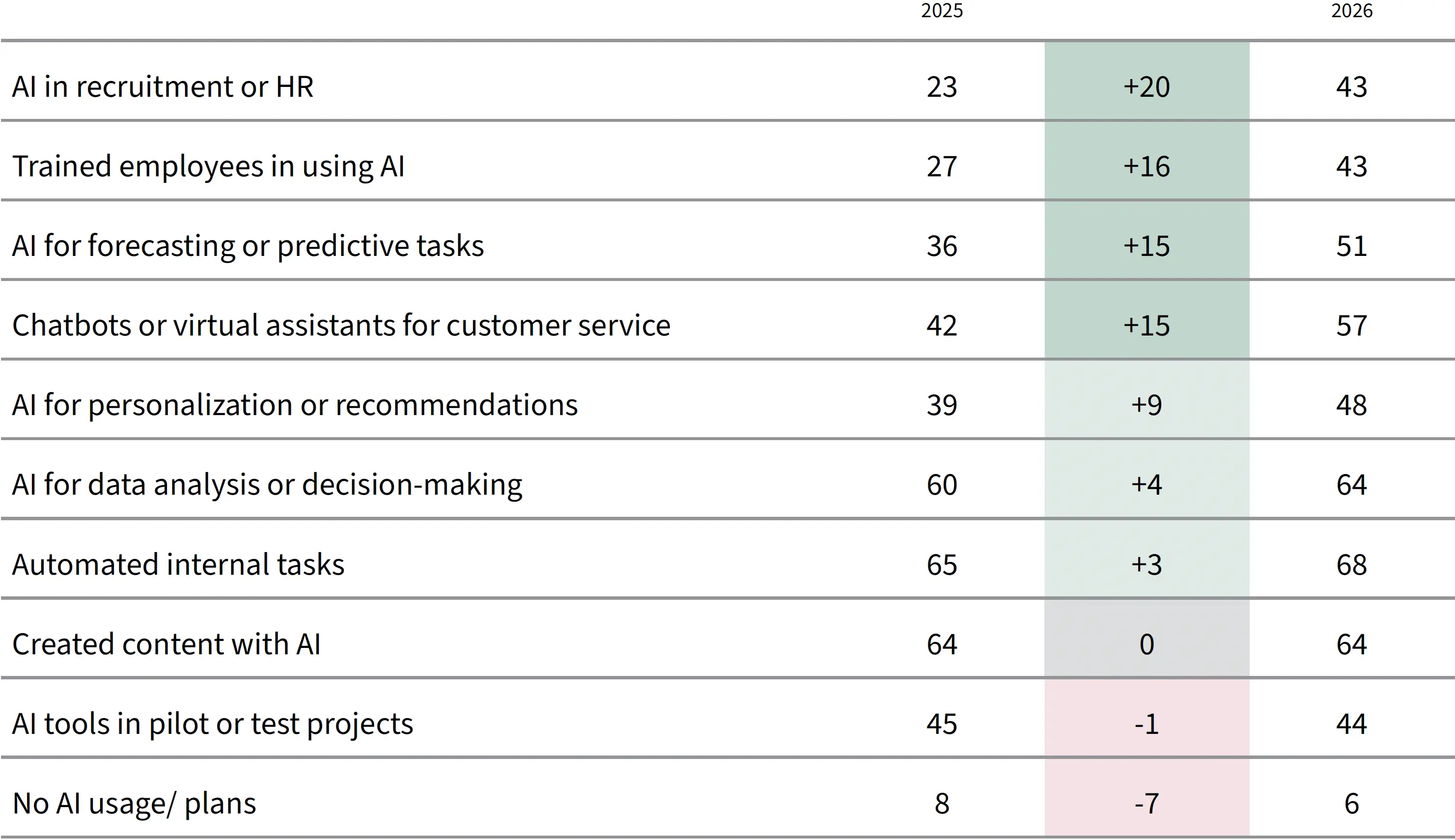
AI Usage Category 2025 vs. 2026
Swarm Technologies, Inc.
5. Most retailers are sitting on the data AI needs, but it is all disconnected.
POS systems, e-commerce platforms, and logistics networks all generate data. But in most Philippine retail organizations they do not talk to each other. AI cannot optimize inventory, forecast demand, or personalize at scale when the underlying data is fragmented across disconnected systems. The infrastructure problem comes before the AI problem.
Exhibit 4
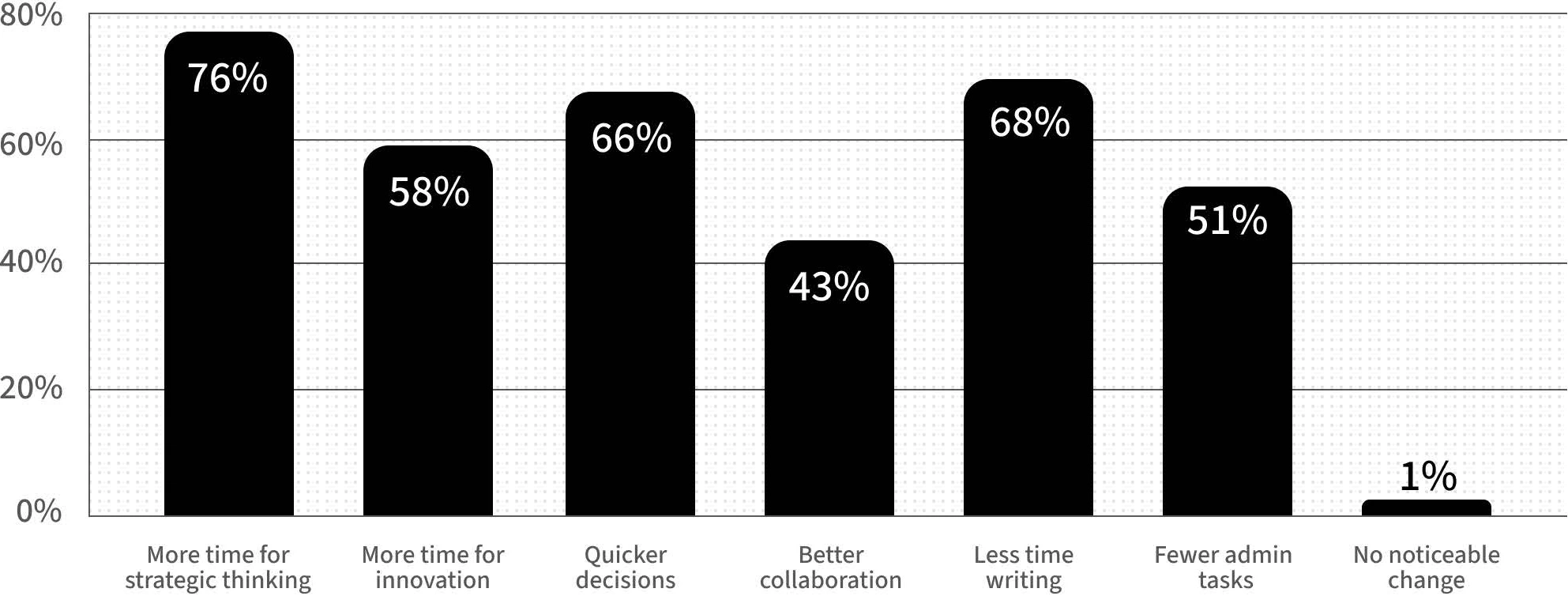
How has generative AI benefited you at work?
Swarm Technologies, Inc.
Find out what’s holding AI back in your organization
1. The Philippine Retail AI Baseline. Where retail organizations stand on AI adoption and how the 2026 energy emergency changed the operating environment.
2. Where AI Creates Value for Retail. Demand forecasting and inventory optimization, logistics cost management, back-office productivity, and customer experience and personalization.
3. What Stands Between Pilots and Production. Skills gaps, shadow AI risk, data fragmentation, and the compliance environment under NPC Advisory 2024-04.
4. From Pilots to Production. How to set up a control tower, provision enterprise AI, invest in data infrastructure, and build AI skills across the retail workforce.
Access the Report
Read the full version in PDF format.
Thank you! Your submission has been received!
Oops! Something went wrong while submitting the form.
About the Authors
Dexter Ligot-Gordon
Contributor
Sets strategic direction as Co-Founder and Chief Executive Officer at Swarm.
Alexis Collado
Producer
Oversaw production as Co-Founder and Chief Design Officer at Swarm.
Tim Santos
Project Lead
Leads product, AI, and cloud at Graphcore and managed the report.
Pia Besmonte Ligot-Gordon
Lead Writer
Heads editorial and content design at Swarm and led the report’s narrative.
Lennon Villanueva
Lead Designer
Led the visual design and brand execution of the report.
Kir Peñalber
Designer & Developer
Designed and developed the report’s landing page.
Frequently Asked Questions
What is the Philippine AI Report 2025?
The Philippine AI Report 2025 is a nationwide study of AI adoption across 175 organizations, produced by Swarm. The survey covered 47 questions across six domains: organizational demographics, AI leadership and governance, current tools and use cases, workforce impact, implementation barriers, and 2026 investment priorities. The full report includes expert commentary from practitioners across the Philippine AI ecosystem, regional benchmarks against five ASEAN neighbors, and a practical roadmap for scaling AI beyond pilots.
Who was surveyed?
Respondents came from a cross-section of Philippine industry. Technology and IT services made up 37% of the sample. Financial services accounted for 14%. The remaining half spanned professional services, healthcare, retail, energy, manufacturing, government, education, and nonprofits. 40% of respondents hold C-suite or senior executive roles. Mid-level managers and individual contributors each represent 21%. Organization sizes ranged from sub-100 employee firms (55% of the sample) to enterprises with 10,000+ employees (13%). The sample skews toward tech and smaller organizations, which reflects the Philippine business landscape. Findings about specific industries or very large enterprises should be read with that composition in mind.
What is the headline finding?
Over 92% of Philippine organizations have used AI in some capacity. Yet 65% remain stuck at proof-of-concept. The country has crossed the adoption threshold. The open question is whether organizations can convert experimentation into enterprise capability before the competitive window narrows.
What are organizations using AI for today?
The most common use cases center on internal efficiency. Automating repetitive tasks leads at 65%. Content creation follows at 64%. Data analysis and decision support reaches 60%. Customer service chatbots sit at 42%. Personalization and recommendations reach 39%. Predictive analytics and forecasting stand at 36%. AI in HR and recruitment is at 23%. The pattern: individual productivity gains come first. Deeper organizational use cases (forecasting, customer service integrated with company systems) require more integration work and remain less adopted.
Which AI tools are Philippine organizations using?
ChatGPT dominates at 83%. Gemini follows at 62%. Claude reaches 44%. Microsoft Copilot and Azure OpenAI services sit at 39%. GitHub Copilot is at 28%. Developer tools tell a different story. Only 12% of organizations use ML frameworks like PyTorch or TensorFlow. Just 10% use NVIDIA's CUDA for AI computation. Most organizations are consuming AI through off-the-shelf platforms. Very few are building or fine-tuning models internally.
What is "shadow AI" and why does it matter?
Shadow AI happens when employees adopt AI tools on their own, sometimes paying out of pocket for premium subscriptions, without formal organizational oversight. The survey shows this across organizations of all sizes. The upside: it signals genuine workforce enthusiasm and real productivity gains. The risk: sensitive data flows into third-party systems without security review. Outputs get integrated into workflows without quality controls. Teams adopt different tools with no coordination. The organization loses visibility into how AI is actually being used. For regulated sectors like banking and financial services, this creates significant compliance exposure. The practical response is channeling grassroots adoption into sanctioned tools with appropriate guardrails.
Is AI replacing jobs in the Philippines?
In 84% of organizations, AI adoption has proceeded with zero AI-related layoffs. About 9% of companies reported modest reductions of 1 to 100 positions. About 4% saw larger cuts, likely in very large organizations or BPO operations heavily exposed to automation. Employees report meaningful productivity gains. 76% say AI frees up time for strategic work. 66% cite faster decision-making. 68% spend less time on writing tasks. The current pattern is augmentation: AI handles routine work so people can focus on higher-value activities. One important caveat. This snapshot comes while most firms remain at pilot stage. As deployment scales, workforce effects will evolve. That makes reskilling and change management investments urgent now, while employment remains stable.
What is stopping organizations from scaling AI beyond pilots?
Five barriers surface consistently. Talent scarcity leads at 57%. Organizations report shortages of data scientists, AI engineers, and technically trained staff. The gap extends to business managers who lack working knowledge of AI capabilities and limitations. Security and privacy concerns follow at 40%, especially in regulated industries. Unrealistic expectations from leadership affect 36%. Internal development hurdles constrain 34%. IT-business friction affects 26%. These barriers compound. Skills shortages make it harder to address security concerns. Security concerns slow deployment. Slow deployments limit the experience that builds skills. Breaking this cycle requires coordinated investment across talent, governance, infrastructure, and change management simultaneously.
How does the Philippines compare to ASEAN neighbors on AI?
The Philippines has strong experimentation momentum and a capable IT-BPM sector. The structural gaps are in national coordination. Singapore has a comprehensive National AI Strategy 2.0 and governance tooling through AI Verify. Malaysia launched a National AI Office with centralized coordination. Vietnam passed comprehensive AI legislation in late 2024, making it one of the first countries globally with an AI-specific law. Indonesia has a long-term AI vision extending to 2045. Thailand is investing in talent development with measurable targets. The Philippines currently has 19 pending AI-related bills and no national AI coordinating body. The country chairs ASEAN in 2026, which creates a window to shape regional frameworks while strengthening domestic ones.
What are organizations planning for 2026?
Expansion intent is high across the board. AI in recruitment and HR is projected to nearly double, from 23% to 43%. Customer service automation is expected to grow from 42% to 57%. Forecasting and predictive analytics should expand from 36% to 51%. Employee training is among the fastest-growing planned investments. These projections set up a critical test: whether the momentum of 2025 translates into scaled execution or stalls against the same structural barriers the report identifies.
What should enterprise leaders take away from this? The report's roadmap centers on five priorities.
1. Address the talent gap. Follow the 10-20-70 model from BCG's research: 10% of AI resources to algorithms, 20% to technology, 70% to people and processes. 2. Build security and governance frameworks. Adoption is outpacing controls. Close that gap before shadow AI creates real compliance exposure. 3. Channel grassroots AI use into sanctioned tools. Provide governed alternatives so employee enthusiasm becomes organizational capability. 4. Start with high-impact use cases that deliver ROI quickly. Use early wins to build confidence for deeper integration. 5. Align talent development with the Philippine Skills Framework for Analytics and AI (PSF-AAI) to create shared competency standards across employers, educators, and government.
What does the report recommend for policymakers?
Three priorities stand out. First, establish a national AI coordinating body to consolidate the fragmented landscape of 19 pending bills into coherent policy. Second, develop risk-based governance frameworks, drawing on models from ASEAN neighbors who have moved faster on national AI infrastructure. Third, invest in layered talent development: foundational AI awareness for all workers, practical adoption skills for the broader workforce, and advanced capabilities for specialists. The Philippines' 2026 ASEAN chairmanship creates a strategic window to shape regional standards while accelerating domestic frameworks.
Who produced this report, and how can I get in touch?
The Philippine AI Report 2025 was produced by Swarm, a global AI consultancy that has deployed over 100 AI projects to production across 12 countries. The research team includes practitioners with experience across enterprise AI in the Philippines and the region. Website: swarm.work For research inquiries: pia@swarm.work For enterprise partnerships: chito@swarm.work